
Africa’s digital transformation is accelerating, but the question of connectivity remains far from resolved.
Across the continent, investment in fibre networks, data centres, satellite technology and digital infrastructure continues to grow. Yet millions of people and businesses remain underserved, particularly in communities where geography, affordability and the economics of network deployment continue to limit access.
The challenge is therefore no longer simply about expanding networks but how to build connectivity infrastructure that is affordable, resilient and sustainable, while ensuring that it delivers meaningful value to the people and businesses it is intended to serve.
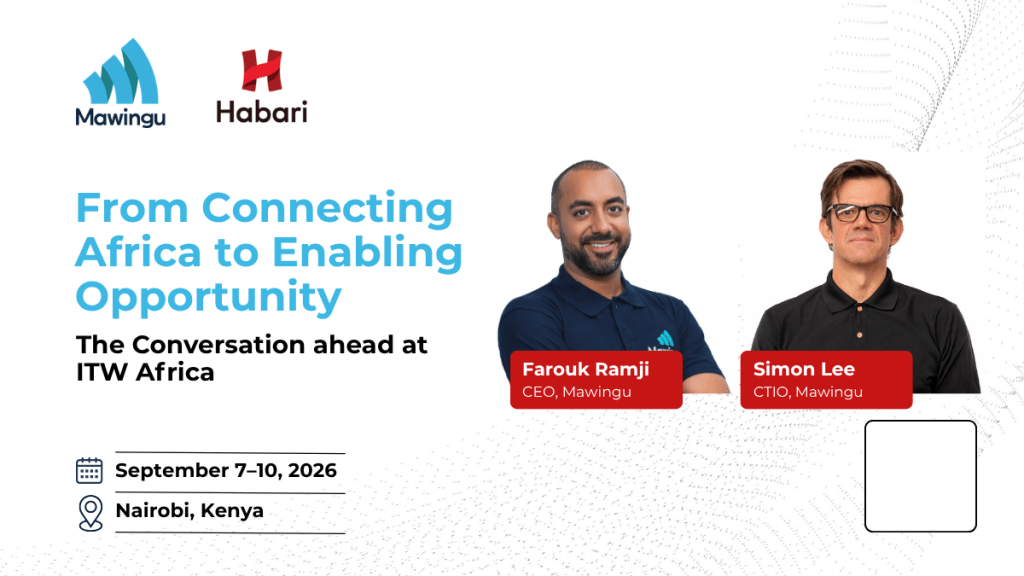
This conversation will be central as industry leaders, technology providers, investors and policymakers gather for ITW Africa, taking place from 7–10 September 2026 in Nairobi, Kenya.
Mawingu CEO Farouk Ramji and Simon Lee, Group Chief Technology and Innovation Officer and General Manager of Habari, will be joining the conversation alongside leaders working across Africa’s telecommunications and digital infrastructure ecosystem.
For Mawingu, ITW Africa presents an important opportunity to engage with a question that continues to shape the future of connectivity across the continent: What will it take to move beyond access and build digital infrastructure that creates opportunity?
The infrastructure challenge is changing
For many years, Africa’s connectivity conversation has focused primarily on coverage.
How many people can be connected? How quickly can networks expand? How much infrastructure is required to close the digital divide?
These questions remain important. However, as technology evolves and demand for reliable connectivity grows, the conversation is becoming more complex.
Connectivity infrastructure must now respond to different realities.
In urban areas, growing populations and businesses require greater capacity and reliability. In rural and underserved communities, the challenge often lies in the cost and practicality of extending traditional infrastructure. Businesses increasingly depend on stable, high-quality connectivity to operate, while households expect internet access to support education, work, communication and access to digital services.
A single technology or infrastructure model will not address all these needs.
The future of connectivity will increasingly depend on how different technologies work together. Fibre, fixed wireless, satellite and other solutions each have a role to play in building networks capable of reaching more people and responding to different market realities.
The challenge is to build these networks in a way that is not only technically possible, but commercially sustainable and accessible to the communities they are designed to serve.
Connectivity must translate into opportunity
The value of connectivity should not be measured only by the number of connections delivered.
Access to the internet is increasingly becoming a foundation for participation in the modern economy. A reliable connection can enable a business to reach customers beyond its immediate location. It can allow students to access educational resources, entrepreneurs to build digital businesses and communities to engage with services that were previously beyond their reach.
This is where the conversation must move beyond infrastructure.
The real question is what happens after a community, home or business is connected.
Does that connection improve access to education? Does it enable businesses to grow? Does it create new opportunities for employment and entrepreneurship? Does it allow communities to participate more fully in the digital economy?
These outcomes should increasingly form part of how the success of connectivity is understood.
For Mawingu, this is central to our approach. Connectivity is not an end but an enabler.
Across our operations in Kenya and Tanzania, we continue to explore how different technologies, partnerships and business models can help extend reliable and affordable connectivity while creating a foundation for broader digital participation.
This requires continuous investment, innovation and collaboration across the ecosystem.
No single player can close the gap
Africa’s connectivity challenge is too significant and too complex to be addressed by one company, one technology or one sector.
Network operators, infrastructure providers, satellite companies, governments, investors, technology companies and local communities all have a role to play.
Partnerships will therefore remain critical.
The infrastructure required to support Africa’s growing digital economy will demand significant investment. At the same time, the sector must find ways to ensure that this investment reaches beyond the most commercially attractive markets.
This is where new models of collaboration and technology deployment become increasingly important.
The integration of terrestrial and satellite technologies, for example, presents opportunities to reach communities that have historically been difficult or expensive to connect. Open and shared infrastructure models can improve efficiency. Strategic partnerships can help accelerate deployment and bring together the expertise and resources required to address different aspects of the connectivity challenge.
The question is not whether Africa has the technology to connect more people.
It does.
The question is how to deploy that technology at scale, sustainably and in a way that ensures connectivity reaches the people and communities who need it.
East Africa’s role in the connectivity conversation
East Africa continues to play an important role in Africa’s digital transformation.
The region is experiencing growing demand for connectivity, increased investment in digital infrastructure and the continued expansion of digital services. Kenya and Tanzania represent markets where innovation, investment and the need for inclusive connectivity continue to converge.
As Mawingu Group continues to build its presence across the region, we see an opportunity to contribute to a broader conversation about what connectivity businesses can achieve.
The future will require us to think beyond traditional definitions of telecommunications.
It will require infrastructure that can adapt to changing technologies and customer needs. It will require business models that recognise the realities of different markets. Most importantly, it will require a continued focus on the impact that connectivity can have on people’s lives, businesses and communities.
This is the conversation we look forward to contributing to at ITW Africa.
Looking ahead
The next chapter of Africa’s connectivity story will not be defined simply by how many kilometres of fibre are deployed, how many towers are built or how many connections are added.
It will be defined by what that infrastructure makes possible.
For Mawingu Group, this means continuing to ask how connectivity can reach further, work better and create greater opportunities for the people and communities we serve.
As Farouk Ramji and Simon Lee join industry leaders at ITW Africa, we look forward to engaging with partners, peers, innovators and decision-makers on the ideas, technologies and collaborations that will shape the next phase of Africa’s digital infrastructure.
If you are attending ITW Africa, we look forward to meeting you, exchanging ideas and exploring how we can work together to build a more connected and digitally inclusive Africa.
Because the future of connectivity is about what those connections make possible.
Opening Opportunities.