
A teacher needs to submit information through an online government portal. The headteacher has administrative work to complete. Students need access to online learning resources. These are everyday activities in many schools, but without internet access, even simple tasks can take more time and money.
Teachers and administrators at Sambul Primary and Junior Secondary School in Garissa Township previously incurred additional costs whenever they needed to access online services. Without a reliable school internet connection, they relied on mobile data bundles or travelled to cybercafés to complete essential tasks.
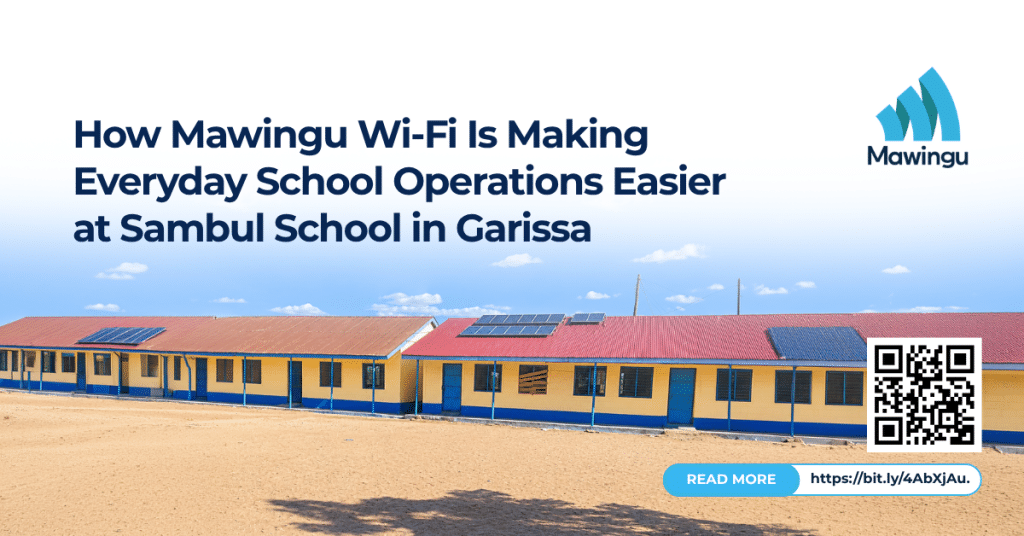
That changed on 29 May 2025, when the Mawingu Foundation connected the school to Mawingu Wi-Fi.
Since then, internet access has become part of the school’s daily operations, helping teachers complete administrative tasks, giving learners more opportunities to access digital learning resources and reducing the school’s expenditure on mobile data.
Making School Administration More Efficient
For schools, internet access is not just about browsing or communication. It is an important tool for managing administrative responsibilities and accessing government education services.
Teachers and the headteacher can now access platforms such as the Kenya National Examinations Council (KNEC), National Education Management Information System (NEMIS) and Teacher Performance Appraisal and Development (TPAD) without leaving the school.
Previously, completing tasks on these platforms could mean purchasing additional data bundles or visiting a cybercafé. The headteacher says work that would ordinarily be done at a cybercafé can now be handled by teachers and the school administration within the institution.
This has made everyday administrative work more convenient while reducing the costs associated with accessing internet services elsewhere.
The school also reports savings on mobile data bundles, allowing it to make better use of the resources that would otherwise go towards purchasing data.
Expanding Access to Digital Learning
The benefits of connectivity extend beyond the headteacher’s office.
With internet access available at the school, learners have more opportunities to explore online educational resources, conduct research and interact with digital content that supports classroom learning.
The school reports improved student grades since gaining access to connectivity. While academic performance depends on several factors, access to additional learning resources gives students more opportunities to explore subjects and develop their understanding beyond the classroom.
For Madam Husna, the change represents something bigger than having internet within the school.
“A teacher in this remote part of the country is getting a better digital experience just like in other parts of the country,” she says.
Her observation speaks to the importance of extending digital opportunities beyond major towns. Teachers and learners in underserved communities should have access to the same online resources and opportunities available to those in better-connected areas.
Turning Connectivity into Additional Revenue
Internet connectivity has also created opportunities for Sambul School to make better use of its facilities
The school has started renting out its halls to external users, with internet access adding value to the spaces available for hire. According to the school, this has created an additional source of revenue.
This is another way connectivity can benefit educational institutions. Beyond supporting teaching and administration, internet access can help schools make better use of their existing resources and identify opportunities to generate additional income.
For institutions working with limited budgets, such opportunities can contribute to their ability to support day-to-day operations.
Opening More Opportunities Through Connectivity
The experience at Sambul Primary and Junior Secondary School reflects the wider purpose of the Mawingu Foundation’s work in underserved communities.
Through its connectivity initiatives, the Foundation supports schools and other institutions that face barriers to accessing reliable and affordable internet. The aim is to make digital opportunities more accessible, particularly in communities where connectivity has traditionally been limited.
Farouk Ramji, CEO of Mawingu, explains the thinking behind this approach:
“When we connect a school, we are investing in more than infrastructure. We are investing in learners, educators, and communities. Through Mawingu Foundation, we aim to ensure that schools have the tools and connectivity they need to access knowledge, improve efficiency, and participate fully in the digital economy.”
This vision is reflected in the experiences of other schools supported by the Mawingu Foundation.
Tumaini Boys Secondary School in Garissa has also experienced the benefits of connectivity, with teachers accessing education platforms and students using online resources to support their research and academic activities.
Tetu Senior School, internet access is supporting the transition to more efficient digital school administration, including student registration, financial records and communication with education offices.
Meanwhile, Katheka Kai Primary School in Machakos County, teachers are incorporating online videos, images and educational resources into classroom lessons to make learning more engaging.
Each institution has its own needs, but the common thread is the opportunity that connectivity creates when teachers and learners can access and use digital resources.
At Sambul School, that opportunity is visible in the everyday work of teachers, the learning experiences available to students and the additional value the institution is creating from its facilities.
Through the Mawingu Foundation, Mawingu continues to work towards a future where access to digital opportunities is not determined by where a school or community is located.
Because connecting a school is only the beginning. What matters is what teachers, learners and the wider institution can achieve once they are connected.
Visit the Mawingu Foundation website or contact charles.watiri@mawingu.co to learn more about its digital inclusion initiatives and work with underserved communities.